If your doctor has ordered an MRI and you live in New Jersey, you have a choice most patients do not realize they have: an open MRI or a closed MRI. Understanding the difference can affect your comfort, your ability to complete the scan, and in some cases, even your out-of-pocket cost.
This guide was written for NJ patients who want a clear, honest comparison before deciding where to have their scan.
What Is a Closed MRI?
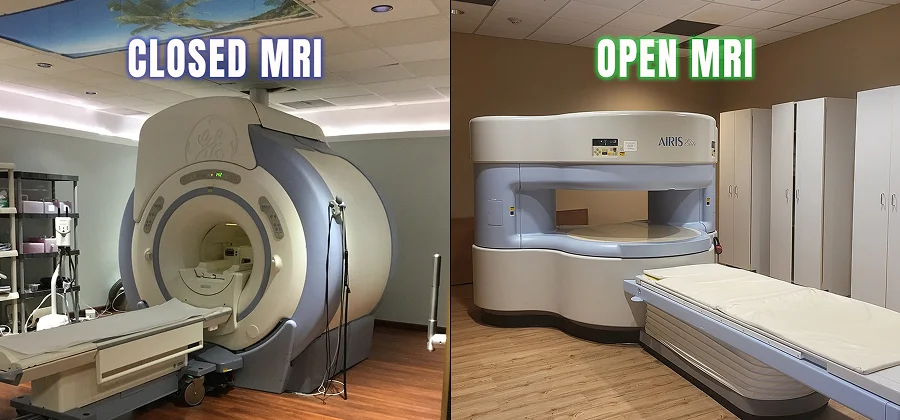
A closed MRI, also called a traditional or conventional MRI, is the most widely available type of MRI machine in New Jersey and across the country. The patient lies on a table that slides into a narrow cylindrical tunnel. The tunnel is typically 60 to 70 centimeters wide, and the scan is performed inside this enclosed space.
Closed MRI systems generally operate at higher magnetic field strengths, most commonly 1.5 Tesla (T) or 3.0 Tesla. Higher field strength historically produced sharper images faster, which is why closed systems became the standard in radiology departments and hospital outpatient centers.
The drawbacks are well documented. The enclosed tunnel creates significant anxiety for a large proportion of patients. Studies published in journals including the American Journal of Roentgenology have estimated that between 4% and 37% of patients experience some degree of claustrophobia during MRI scans, with a meaningful percentage requiring sedation or abandoning the scan entirely. (Source: American Journal of Roentgenology)
What Is an Open MRI?
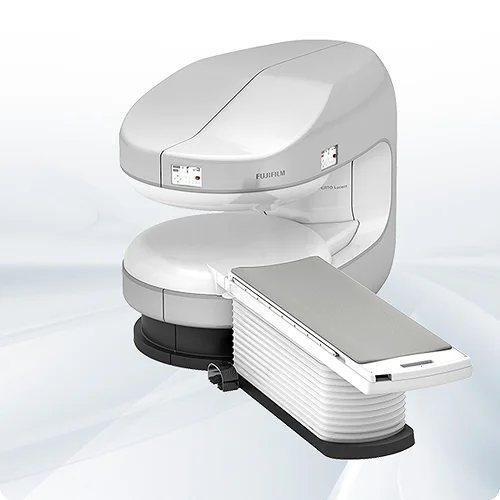
An open MRI eliminates the enclosed tunnel design. Instead of a cylindrical bore, the magnet is positioned above and below the patient, leaving all four sides open. The patient lies on a table in a spacious environment with unobstructed views in every direction.
Early open MRI systems had a reputation for lower image quality because they operated at lower field strengths than closed systems. This was a legitimate concern a decade ago. Modern open MRI technology has significantly narrowed that gap, and the best current systems produce diagnostic-quality images appropriate for the full range of clinical applications.
At Open MRI 17 in Paramus, we use the Aperto Lucent HD, the first AI-powered open MRI installed in the United States. The AI processing layer built into this machine compensates for the inherent differences in field strength by enhancing image sharpness and correcting for minor motion during the scan. The result is open MRI imaging that meets the diagnostic standards your physician needs.
Open MRI vs. Closed MRI: The Key Differences
| Feature | Closed MRI | Open MRI (Aperto Lucent HD) |
|---|---|---|
| Design | Narrow enclosed tunnel | Open on all sides, 270-degree design |
| Patient comfort | Can cause significant anxiety | Comfortable, claustrophobia-free |
| Typical field strength | 1.5T to 3.0T | Lower field, AI-enhanced |
| Weight limit | Often 350-450 lbs | Up to 660 lbs |
| Noise level | Loud repetitive banging | Significantly quieter |
| Ideal patients | General population | Claustrophobic, bariatric, pediatric, elderly |
| Report turnaround | Varies | 24 to 48 hours at Open MRI 17 |
Does Open MRI Produce Lower-Quality Images?
This is the most common concern patients raise, and it deserves a direct answer.
Older open MRI systems did produce images with less detail than high-field closed systems. If someone had an open MRI scan 10 or 15 years ago and their doctor expressed concerns about image quality, that feedback reflected the technology of that era.
The Aperto Lucent HD is a different generation of machine. The AI processing layer built into the system works in real time to sharpen images and reduce artifacts, effectively boosting the diagnostic value of images beyond what the hardware alone would produce. Our board-certified radiologists read these images daily and deliver reports that your referring physician can act on with confidence.
For the vast majority of clinical indications including spine, knee, shoulder, brain, and abdominal imaging, the Aperto Lucent HD produces images that fully meet diagnostic standards. There are some specialized neurological protocols where a closed 3.0T system may be preferred, and in those cases your physician will specify. But for the overwhelming majority of MRI referrals, open MRI at Open MRI 17 delivers what your doctor needs.
Who Should Choose an Open MRI in NJ?
Patients with claustrophobia or scan anxiety. This is the most important use case for open MRI. If you have previously been unable to complete a closed MRI, needed sedation for an MRI, or are simply dreading the enclosed experience, an open MRI is the right choice. Most patients who come to us after a difficult experience at a traditional facility complete their scan without any anxiety management at all.
Bariatric patients. Many closed MRI systems have weight limits between 350 and 450 pounds. The Aperto Lucent HD accommodates patients up to 660 pounds. Body size should never be a reason a patient cannot get a diagnosis.
Pediatric patients. Children often struggle with closed MRI. The loud noise, tight space, and need to remain still for an extended period can make conventional MRI very difficult for young patients. Open MRI systems are quieter and far less intimidating, reducing the frequency of sedation in pediatric scanning.
Elderly patients. Older patients with limited mobility, cognitive anxiety, or difficulty lying still in a confined space often do significantly better in an open system.
Patients who were previously unable to complete an MRI. If your scan was abandoned or incomplete at another facility, we encourage you to try our open system before accepting that outcome.
Who Might Still Need a Closed MRI?
Most patients do not need the additional field strength of a 3.0T closed system for their specific diagnosis. However, there are situations where your physician may specifically request a closed 3.0T scan:
- Highly detailed neurological imaging (small brain lesions, epilepsy evaluation)
- Certain cardiac MRI protocols
- Some pediatric brain and spine protocols where subspecialty radiologists require 3.0T images
In these cases, your referring physician will typically specify the field strength required when writing the order. For the large majority of MRI referrals in NJ, an HD open MRI produces exactly what is needed.
Insurance: Does It Cover Open MRI in New Jersey?
Yes. Open MRI is a standard covered imaging service under most major insurance plans in New Jersey, including Medicare and Medicaid, when ordered by a physician with a clinical indication. Coverage is subject to your plan’s deductible and co-pay, just as it would be for any imaging service.
Open MRI 17 accepts most major insurers and verifies your coverage before your appointment. If you have questions about whether your specific plan covers open MRI, call us at (201) 368-2005 and our team will confirm your benefits before you book.
Real Patient Scenarios: Which MRI Would Work for You?
Maria, 58, referred for a lumbar spine MRI after back pain Maria mentioned during scheduling that she had been anxious during a brain CT years ago and was worried about the MRI. She came to Open MRI 17, completed her lumbar spine scan comfortably with no anxiety medication, and her physician received the report the next morning. Open MRI was the right choice.
David, a 12-year-old referred for a knee MRI after a sports injury His mother called asking whether they could avoid sedation. Our team explained the open design, he came in with his mom in the room during the scan, and the whole thing was done in 25 minutes. No sedation needed.
Sandra, referred for MRI of the brain to evaluate headaches Her neurologist did not specify a field strength requirement. Sandra had mild claustrophobia and chose our open MRI. The scan was completed, the radiologist report was detailed and complete, and her neurologist moved forward with her evaluation from it. Open MRI was appropriate for her clinical needs.
Open MRI in Bergen County: Book at Open MRI 17
If you have been referred for an MRI in New Jersey and want to discuss which option is best for your situation, our team is happy to help. We serve patients from Hackensack, Teaneck, Fort Lee, Clifton, Wayne, and communities throughout Bergen, Passaic, Hudson, and Essex Counties from our Paramus location on Route 17.
Same-week appointments are available. For more information about the technology we use, visit our AI MRI page or read more about our HD Open MRI service.